HolaCeylon (HC Travels)
Your Unique Travel partnerTrains and Tuktuks
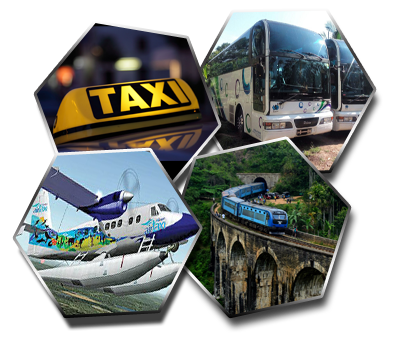
You will be met at Colombo Airport by your professional Holaceylon English-speaking guide and driver who will accompany you on your tour. If you are not English-speaking, Holaceylon will do its best to provide a guide speaking your language. Your car (or small van, depending upon the number in your party) will be comfortable, air-conditioned, and very well maintained. Sri Lankan roads are usually excellent although a few routes are very busy, and in the hills bendy, so average speeds are not high, except on the new toll expressways linking Colombo with the airport, and with Galle and Matara in the South. All car expenses will be included in your tour fee. You may wish to experience other forms of local transport for some stretches of your tour. Although buses cover the whole country, even the smallest lanes and villages, they are definitely not the most comfortable way of getting around, as you will easily observe from your own car! However, the railway line up from Colombo to Kandy, and then continuing over and through the hills and tea gardens to Badulla, is spectacular – one of world’s great rail journeys – and your driver can arrange for you to travel on all or a part of it. He can also fix rides for you on ‘tuk-tuks’, weaving in and out of the traffic, the perfect way of getting around quickly in towns, or even a little further afield. These three-wheeled open-sided taxis are somewhat hair-raising, but fun.
Beaches for all Seasons
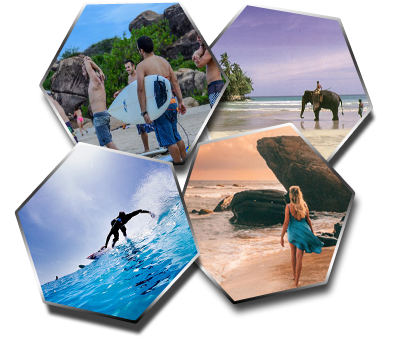
You may be coming to Sri Lanka for its beaches, in which case you are in luck! Because of the island being affected by two monsoons, from the South-west and the North-east, the seas washing its South-west beaches are calm in the northern winter, and those in the East are quiet in the northern summer. Surfers looking for something more exciting may have different ideas about calm and quiet. Sea bathing is a pastime enjoyed by locals as well as visitors, but care must be taken as not all white sand beaches are as safe as they appear: take local advice before leaping in. Surfing has developed rapidly, first along the East coast, particularly famously at Arugam Bay, but more recently all along the South-west shore. The West coast has always attracted many visitors and tourists, being close to Colombo, and is generally busy and much developed, especially around Negombo, Bentota and Hikkaduwa. The South coast is quieter for now but developing fast and has lovely sand at Mirissa, Tangalle and Weligama. The East coast is still sensationally wild, with few hotels but mile upon mile of great wide golden sand. There are resorts at Arugam Bay, Trincomalee and Passikudah, with good roads now connecting them with Colombo over on the other side of the country. Scuba-diving and snorkelling are of course also popular activities, particularly in the East. Come to Sri Lanka’s beaches – and plunge into our clean, warm tropical waters.
Tea and Treks in the Hill Country
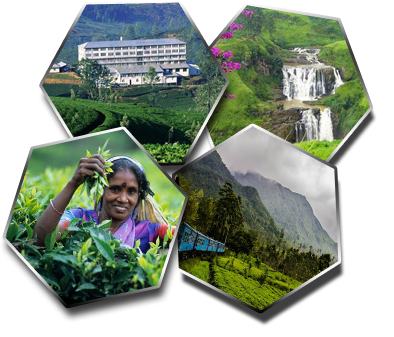
Sri Lanka is very well known for its delicious tea, but much less known are the hills upon which most of it is grown. Tea followed coffee in the 19th century and is still the island’s major export. It has created a bright green hilly landscape all of its own and little towns, villages and bungalows, and a railway line, to serve it. Hills rise to over 8000 feet; cool water cascades off them in marvellous waterfalls over huge cliffs, particularly on their Southern edges; viewpoints such as World’s End and Lipton’s Seat, not to mention Adam’s Peak, are spectacular destinations for walks and treks of a wide range of difficulty. Your guide may take you to one of many tea factories where the tea processing can be seen, or to lovely pools and streams in the foothills where you can relax from the twists and turns of the hill country roads. Nuwara Eliya (‘Little England’) is the best-known hill town that in its buildings, race course and gardens, retains vestiges of its colonial origins. Holaceylon may have arranged for you to stay in a converted tea factory or in a small villa or boutique hotel in the hills. But if you travel in this beautiful high countryside in December or January, be sure to bring a sweater, for at night it can be very chilly; not all rooms have open log fires.
Beasts and Birds
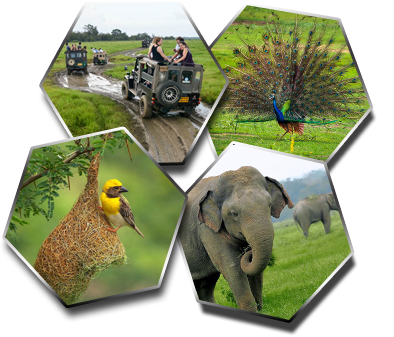
Sri Lanka has the greatest density of elephants of any country in Asia. It’s the country in the world where you are most likely to see usually shy leopards. You can take a boat from Mirissa and watch amazing leaping flotillas of several migrating whale species. There are many beautiful national parks, some busy with tourists, others still wild and un-visited. You can explore them in jeeps, or in boats, or on foot. You may also see sloth bears (lucky you!) and other mammals (among 91 native species), crocodiles and many kinds of reptiles. And then you have the birds… Sri Lanka hosts about 430 species, of which 26 are endemics mostly found in the hill country and the South. Many are migrants from the North although most are resident. Bring binoculars: you can watch birds in the national parks, along the shores and mangroves of the coast, in the hills and from the banks of reservoirs and wetlands. The ‘national’ bird is the endemic blue magpie. If you walk in beautiful Sinharaja, a rainforest remnant protected by UNESCO world heritage status, you are likely to see it, and hear it squawking among the silent vastness of the trees. Then, you may be very happy just strolling in the glorious Royal Botanical Gardens at Peredeniya, with its thousands of screeching fruit bats. Holaceylon will discuss with you what sort of wildlife experiences you are interested in. Sri Lanka… a gem of an island for the expert naturalist and the novice.
Exploring a History
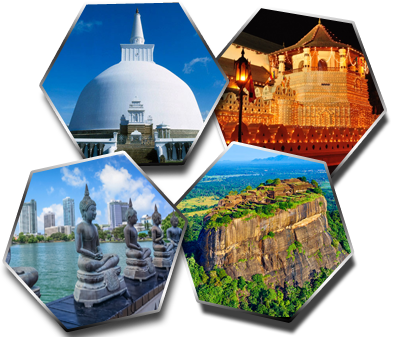
The history of Sri Lanka is written in its fascinating monuments and you can explore it all. The 2600-year-old capital Anuradhapura is where Buddhism was first established and many vast monuments remain from that period. In the northern ‘dry zone’ there are countless reservoirs or wewas, both vast and small, that testify to a highly sophisticated and very old technology for collecting water and irrigating the land, and hence to rich lost kingdoms. Three other UNESCO historical sites – the Golden Cave Temple at Dambulla (1st century BCE), Sigiriya’s rock fortress (5th century), and another abandoned capital city at Polonnaruwa (11th century) – bear witness to the land’s past turbulence and prosperity, and to a great heritage in building, sculpture and painting. The colonial period began with the Portuguese in 1505, who left behind the Roman Catholic religion and many local surnames. Their forts and houses were largely destroyed or rebuilt by the ensuing Dutch, whose surviving monuments include domestic and civic buildings and several very impressive forts, the best known being the UNESCO site at Galle, but there are others at Trincomalee and Jaffna, for example. The British legacy of the 19th and 20th centuries is all over the island – massive administrative and commercial buildings in Colombo and elsewhere, the tea estates that completely changed the hill country, the railway system. Your Holaceylon tour guide will help you be selective of all these wonders, and many more, as there is so much to see in this small country.
Temples and Traditions
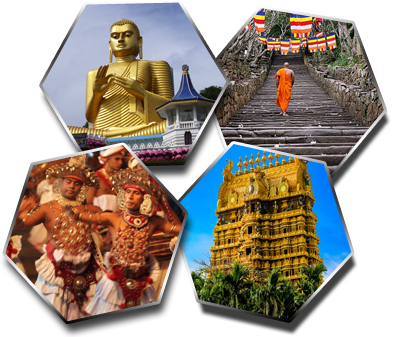
Over much of the country you will see the multi-coloured striped Buddhist flag fluttering, most often close to Buddhist temples and their ubiquitous hemispherical stupas. But you will also see, particularly in the North and East, in Colombo and in the hill country, Hindu temples, or kovils, often large and sometimes tiny, exuberantly carved and painted. You will also see minarets pointing javelin-like into the island sky. And finally, mostly down the West coast North and South of Colombo, and in the capital, you will find Christian (mostly Roman Catholic) churches, and roadside shrines containing images of Mary and Jesus and other saints. About 70% of the population adheres to Buddhist traditions, with about equal smaller numbers of Hindus, Muslims and Christians. Each tradition is celebrated with its own festivals and holidays. There are places of pilgrimage visited by throngs of worshippers: the most famous are the Temple of the Tooth Relic in Kandy (Buddhist), the shrine of Skanda/Muruka at Kataragama in the remote South-east that attracts both Hindus and Buddhists and the Hindu Koneswaram temple at Trincomalee. Many Sri Lankans travel to the ancient capital at Anuradhapura to worship around a bo tree grown from a cutting of the actual tree under which the Buddha obtained Enlightenment at Bodhgaya in India. By far the best-known of the many wonderful festival processions is the great perahera at Kandy in August, but there are local peraheras all over the country at various times of the year.
Welcomes and Wellness
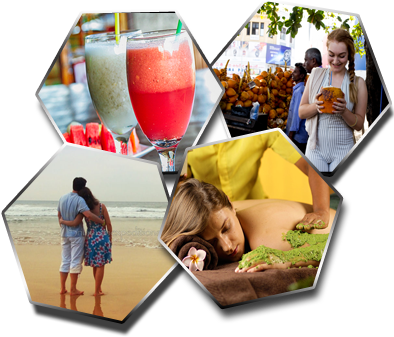
In the early stages of the planning of your tour, Holaceylon will discuss with you the kind of accommodation you would like: we will describe the huge range of possibilities. In all parts of Sri Lanka, whether in the Hill Country, or in the cities, or close to the national parks, or along the coasts, there is a very wide selection of places to stay. Some hotels, whether large or of a ‘boutique’ nature, can offer the highest levels of comfort, luxury and service, with prices to match. Some are architectural gems, whether reminding you of a colonial past, or designed by Geoffrey Bawa, doyen of modern Sri Lankan architects, or located in a converted tea factory. Others are collections of cabanas by a beach or in a forest near a national park. There are homestays and apartments, bungalows and villas, indeed accommodation for every taste and every pocket. Large hotels have swimming pools and many are now called ‘resorts’. This means that they include a ‘spa’, a place where you can relax after a day’s travelling or sightseeing and made to feel good in beautiful and aromatic surroundings. Often well-trained masseurs and therapists are on hand, offering many different treatments, usually based on the traditional principles of ayurveda or Indian medicine.
Fantastic Feasts
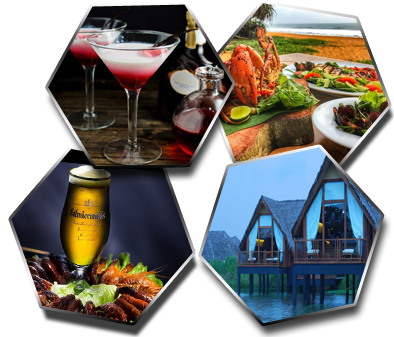
No visit to Sri Lanka will be complete without you sampling and hopefully enjoying the local cuisine. Holaceylon will guide you to their favourite restaurants and you will be delighted and very satisfied. Every ancient and colonial culture has left its mark in the kitchens of Sri Lanka. The typical meal consists of ‘rice and curry’, a rather large portion of rice served with a number of curries – maybe a dozen! – both vegetarian and non-vegetarian. Fish and seafood, not surprisingly in an island nation, is plentiful and very varied – and often deliciously curried also. There are many unfamiliar vegetables to enjoy, along with the non-native species cultivated in the temperate Hill Country. But beware! Sri Lankans enjoy their curries very ‘hot’! Most restaurants will happily adapt the ‘heat’ of their curries to suit foreign palates! European and other food is found quite widely, especially in the cities and larger hotels. Thus, if you don’t fancy rice and curry for breakfast you will probably find a typically Western alternative! There are ‘pastry shops’ everywhere and, of course many fruits too in markets and roadside stalls. As for drinks… tap water is generally safe, but many visitors will be happier relying upon bottled water, which is available everywhere. Sri Lankan tea is of course very famous, sweet and milky unless you ask otherwise, whereas coffee is less reliable. Stronger stuff consists principally of locally brewed lager, and arrack, a spirit distilled from the sap of flowers of the coconut palm. Locally made gin, whisky and vodka are also available, as well as considerably more expensive imported brands. The better hotels offer extensive lists of imported wines.